Gyrotonic Palo Alto sessions offer a different way to think about movement, especially for people who already use massage, physical therapy, yoga, strength training, or other wellness practices.
Most people do not wake up one morning and decide they need a completely new movement system.
Usually, the realization happens gradually.
A stiff shoulder starts making overhead movements uncomfortable.
Sitting through a long workday leaves the hips feeling locked.
A recurring ache disappears after a massage, only to return a few days later.
These small patterns can make people wonder whether their wellness routine is missing something.
That is where movement-based practices can become valuable.
Instead of treating wellness therapies as competing options, it can be more useful to see them as different parts of the same puzzle.
Someone may use massage to reduce muscular tension, physical therapy to recover function, and a structured movement practice to develop greater control, coordination, and mobility.
For people interested in exploring this approach, gyrotonic Palo Alto sessions can provide a movement-focused complement to an existing wellness routine.
Why Wellness Often Requires More Than One Approach
The human body does not operate in isolated sections.
A tight shoulder can be influenced by the rib cage.
Restricted hip movement can change the way a person walks.
Limited spinal mobility may affect how comfortably someone reaches, twists, or bends.
This is why relying on a single wellness method does not always produce the complete result a person wants.
Consider a common example.
Imagine someone who works at a computer for eight or nine hours every day.
By Friday evening, the neck feels tight, the upper back feels stiff, and the shoulders naturally round forward.
A massage may provide welcome relief.
However, if the person returns to the same movement habits without improving mobility or body awareness, the tension may gradually return.
A movement system built around circular patterns, spinal articulation, and coordinated breathing approaches the problem from another direction.
Rather than simply addressing the sensation of tightness, the practice encourages the body to explore more efficient ways of moving.
How Gyrotonic Exercise Differs From Conventional Training
Traditional exercise often focuses on measurable outcomes.
Lift more weight.
Complete more repetitions.
Run farther.
Hold a position longer.
Those goals can be useful, but movement quality deserves equal attention.
The Gyrotonic Method uses flowing, three-dimensional movement patterns rather than relying only on straight-line exercises.
The spine can flex, extend, rotate, and move through spiraling patterns.
The arms and legs work in coordination with the trunk instead of always being trained as separate parts.
Breathing is also integrated into the movement process.
This combination can feel unfamiliar during an initial session.
Many people are used to exercise that feels obviously intense.
They expect burning muscles, heavy breathing, or exhaustion to prove that something productive happened.
A mobility-focused session can challenge the body differently.
The challenge may come from coordination, precision, control, or discovering movement in an area that has felt restricted for years.
The Difference Between Moving More and Moving Better
More movement is not automatically better movement.
A person can perform hundreds of repetitions while repeatedly using the same compensations.
For example, someone with limited shoulder mobility may arch the lower back every time the arms reach overhead.
The arms technically reach the destination, but the movement is not necessarily coming from the intended areas.
A trained instructor can observe these patterns and guide the person toward a more organized movement strategy.
The goal is not perfection.
The goal is greater awareness and more options.
That distinction matters because daily life rarely happens in perfect gym positions.
People twist to reach into the back seat of a car.
They bend while carrying groceries.
They rotate while playing sports.
They reach awkwardly for objects on high shelves.
Training the body through varied movement pathways can help prepare it for these everyday demands.
Complementing Massage Therapy With Active Movement
Massage therapy and movement training can work well together because they serve different purposes.
Massage is largely passive from the client’s perspective.
The therapist works with soft tissue while the client receives the treatment.
Movement practice is active.
The individual must participate, coordinate, breathe, and control the body through each sequence.
Imagine a person who regularly experiences tightness around the upper back.
After massage therapy, the area may feel noticeably more relaxed.
A movement session can then help the person explore how the rib cage, spine, shoulder blades, and arms work together.
This can turn temporary relief into an opportunity for better movement awareness.
The two practices are not interchangeable.
They can be complementary.
One may help reduce tension, while the other helps a person understand how habitual movement patterns contribute to that tension.
Supporting Physical Therapy and Post-Rehabilitation Movement
There is often a difficult gap between finishing rehabilitation and returning to unrestricted exercise.
A person may be medically cleared but still feel hesitant.
The injury may no longer require intensive treatment, yet confidence in movement has not fully returned.
This is where carefully guided movement can play a useful role, provided it is appropriate for the individual and coordinated with medical advice when necessary.
Suppose someone has completed rehabilitation after a period of limited activity.
Basic function has returned, but twisting, reaching, or moving through larger ranges still feels unfamiliar.
Jumping immediately into aggressive training may not feel appropriate.
A progressive movement practice can provide a bridge between basic rehabilitation exercises and more demanding physical activity.
The emphasis on controlled range, coordination, and gradual progression can help people reconnect with movement without treating every session like a fitness test.
Building Confidence Through Controlled Range
Confidence is an underrated part of physical wellness.
After discomfort or injury, people often become cautious without realizing it.
They stop rotating fully.
They avoid bending in certain directions.
They unconsciously shift weight away from one side.
Over time, these protective habits can become normal.
Guided movement offers a structured environment for exploring range gradually.
The process can be surprisingly revealing.
A person may discover that one side rotates easily while the other feels restricted.
Another person may notice that breathing changes when movement becomes challenging.
Someone else may realize that the shoulders are constantly working during exercises that should involve more support from the trunk.
These discoveries are valuable because awareness often comes before meaningful change.
Why Spinal Mobility Matters for Everyday Life
The spine is involved in almost everything people do.
Walking requires subtle rotation.
Reaching involves coordinated movement through the spine, ribs, shoulders, and arms.
Even sitting comfortably requires the ability to adjust position.
Yet many modern routines reduce movement variety.
People sit in cars.
They work at laptops.
They look down at phones.
They repeat the same gym exercises in predictable movement planes.
Over time, the body can become very good at the movements it performs regularly and less comfortable with the ones it rarely explores.
Gyrotonic exercise places significant attention on spinal movement.
Arching, curling, spiraling, and circular patterns encourage the spine to move through multiple directions.
The intention is not to force flexibility.
It is to develop controlled mobility.
That difference is important.
Flexibility describes available range.
Mobility involves the ability to control movement within that range.
For daily life, both matter.
Combining Mindful Movement With Yoga and Pilates
People who already practice yoga or Pilates may find certain concepts familiar.
Breathing matters.
Alignment matters.
Control matters.
Body awareness matters.
However, the movement experience can still feel distinctly different.
Yoga often includes held postures, transitions, and sequences performed primarily on a mat.
Pilates frequently emphasizes core control, stability, and precise movement patterns.
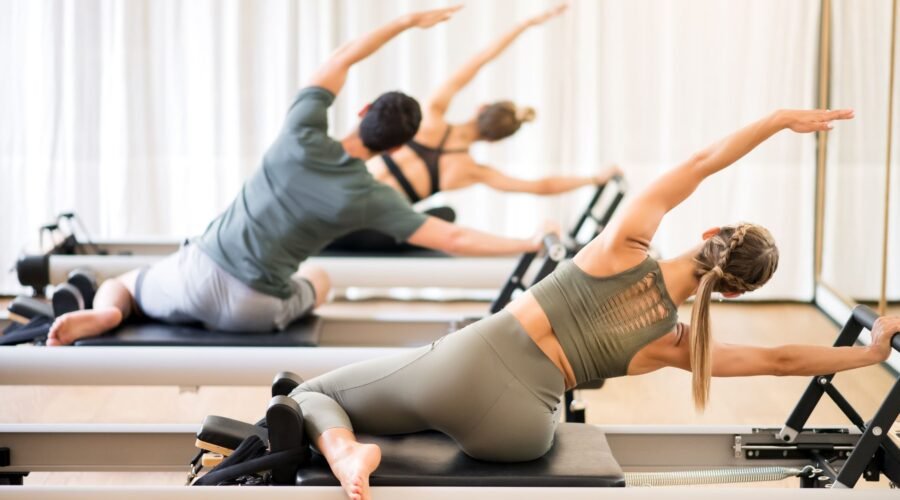
The Gyrotonic Method adds another perspective through continuous circular and spiraling motion, often supported by specialized equipment.
A person does not necessarily need to choose one practice and abandon the others.
Someone might enjoy yoga for its combination of movement and mindfulness.
They may use Pilates to develop control and stability.
They might add Gyrotonic sessions to explore fluidity, rotation, and three-dimensional movement.
The right combination depends on individual goals, schedule, physical history, and personal preference.
What a First Session May Feel Like
Walking into a new movement studio can be intimidating.
The equipment may look unfamiliar.
The exercises may not resemble anything seen in a typical gym.
That uncertainty is normal.
An introductory session will generally involve learning fundamental movement patterns and becoming familiar with the equipment.
The instructor may observe posture, breathing, coordination, and general movement tendencies.
The experience can be humbling in an interesting way.
A physically strong person may discover that slow, coordinated circular movement requires unexpected concentration.
A flexible person may realize that having a large range of motion is different from controlling it precisely.
A regular runner may notice how unfamiliar spinal rotation feels.
The value of an introductory session is not proving fitness.
It is discovering how the body currently moves.
Small Improvements Can Be Meaningful
Not every wellness improvement needs to be dramatic.
Sometimes progress means turning the head more comfortably while reversing a car.
Sometimes it means reaching overhead without automatically lifting the shoulders.
Sometimes it means finishing a workday without feeling desperate to stretch the lower back.
These changes may seem small, but they affect everyday comfort.
A useful movement practice should connect with life outside the studio.
The goal is not simply to become better at performing exercises.
The larger purpose is to develop movement skills that support daily activities, hobbies, recreation, and long-term physical confidence.
Creating a More Complete Wellness Routine
A strong wellness routine does not need to contain every available therapy or exercise method.
It needs to make sense for the individual.
Someone dealing with muscular tension may benefit from combining hands-on therapy with active movement.
Someone returning from rehabilitation may need a gradual transition toward more complex exercise.
A desk-based professional may prioritize spinal mobility, posture awareness, and movement variety.
An athlete may want better rotational control and coordination alongside conventional strength training.
The common theme is integration.
Wellness practices tend to be most useful when they address different needs rather than duplicating the same approach.
Recovery matters.
Strength matters.
Mobility matters.
Coordination matters.
So does consistency.
A thoughtfully designed movement practice can connect several of these elements without turning wellness into another exhausting obligation.
Finding a Sustainable Approach to Better Movement
The most effective movement routine is rarely the most extreme one.
It is the one a person can understand, practice consistently, and adapt as needs change.
Gyrotonic Palo Alto sessions can fit into that broader picture by giving people another way to explore mobility, coordination, breathing, and controlled three-dimensional movement.
For some, it may complement regular massage therapy.
For others, it may support the transition from rehabilitation into more active exercise.
It may also provide yoga practitioners, Pilates enthusiasts, athletes, and desk-based professionals with a fresh way to understand how their bodies move.
The real value is not in chasing a perfect posture or performing complicated exercises.
It is in becoming more aware of movement patterns and developing better options.
When different wellness therapies work together with clear purposes, the result can be a more balanced approach to physical well-being.
That is often the missing piece.
Not more exercise for the sake of exercise, but movement that helps the body become more adaptable, coordinated, and confident in everyday life.
DISCLAIMER: The Site cannot and does not contain medical / health advice. The medical / health information is provided for general informational and educational purposes only and is not a substitute for professional advice. Accordingly, before seeking any form of medical advice, diagnoses or treatment based upon such information, we encourage you to consult with your GP or other qualified health practitioner. You must never disregard professional medical advice or delay in seeking it because of something mentioned on this Site. The use or reliance of any information contained on the Site is solely at your own risk.