
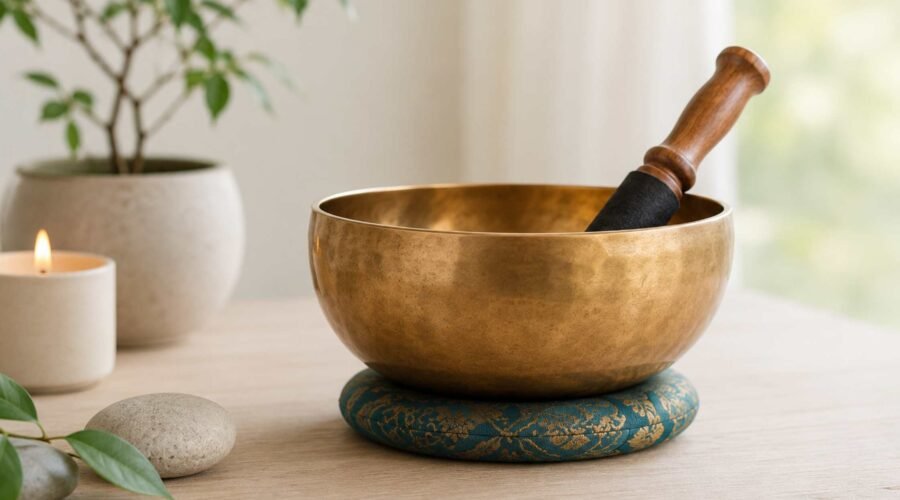
There is a particular image that comes to mind when most people think of a Tibetan singing bowl. Someone sitting cross-legged in a dimly lit room, striking a bowl once, closing their eyes, and waiting for something to happen. Maybe they feel calmer. Maybe they feel nothing in particular. They try it twice more and conclude that singing bowls are probably one of those things that work for other people.
I spent years in that camp myself.
What changed was not finding a better bowl or learning a special technique. What changed was understanding what the bowl is actually for, and realising it is almost the opposite of what most people assume.
A singing bowl is not a passive relaxation device. It is a tool for attention.
That distinction sounds small. In practice it changes everything about how you use one and what you get from the experience.
The attention problem nobody talks about
Most of us approach sound-based wellbeing practices the way we approach music. We put something on, let it wash over us, and hope the mood transfer is sufficient. This works reasonably well for background sound. It works almost not at all for a Tibetan singing bowl, because the bowl is not designed to be passively received.
The reason goes back to how these bowls were actually used. In Tibetan Buddhist practice, a singing bowl marks a transition. The beginning of meditation. A shift from one phase of a practice to another. The end of a session. The sound is a signal to the practitioner to pay attention in a specific, directed way, not to relax and drift.
This is why the experience of striking a bowl and waiting for something to happen tends to disappoint. You have given the attention nowhere to go. The bowl rang. The sound faded. Your mind drifted to whether you left the oven on.
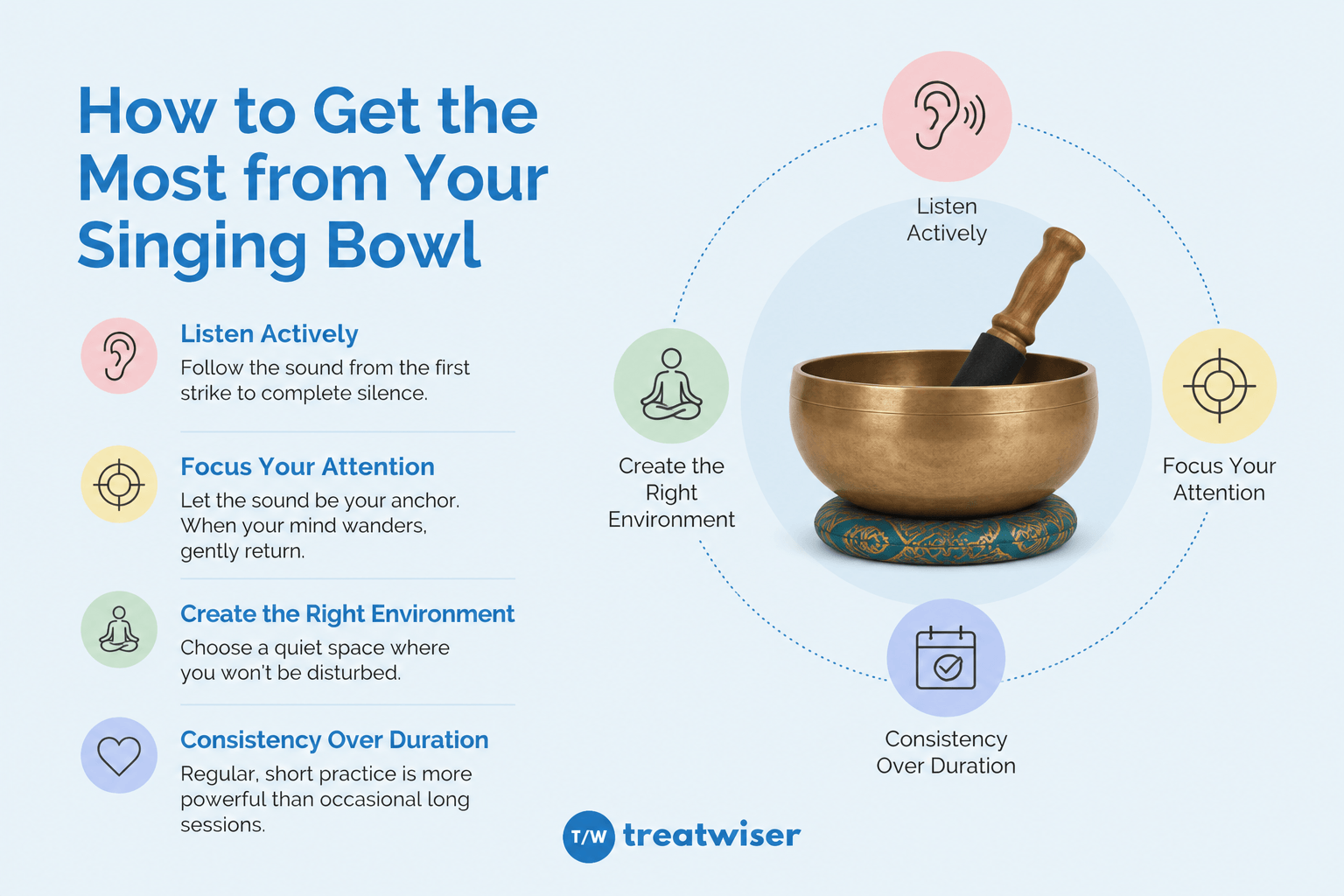
The practice, properly understood, is to follow the sound. To stay with it as it develops through its initial strike, through the bloom of overtones in the middle of its sustain, through the point where it starts to fade, and then further, into the near-silence before it disappears entirely. That full arc takes considerably longer than most people allow for it. And following it all the way is, in itself, a significant act of concentrated attention.
What sustained attention actually does
There is a useful body of research on the relationship between focused attention and physiological states of calm. The mechanism is reasonably well understood. When attention is genuinely engaged on a single point, the kind of background mental activity that generates tension and restlessness has nowhere to operate. The mind is occupied in the most literal sense.
What a singing bowl does well, better than many other objects of attention, is provide something that is both stable and changing. The tone does not disappear immediately, giving the attention something to hold. But it does shift, the overtones moving and fading at different rates, which means the attention is not simply staring at a fixed point but following something that requires a degree of active engagement to track.
This is also why bowl sessions tend to feel shorter than they are. When attention is genuinely absorbed, the background sense of time passing in the way it does when we are bored or restless simply does not operate in the same way. People often report that what felt like five minutes of sitting with a bowl was closer to fifteen or twenty.
Whether that is a useful measure of the experience is worth asking. I think it is. The capacity for absorbed, directed attention is one that most people find increasingly difficult to access in daily life. Anything that rebuilds that capacity, even briefly, tends to have effects that extend beyond the session itself.
The sound you are not listening to
Something I find genuinely fascinating about Tibetan singing bowls, after years of working with them, is that most of what makes a good bowl interesting is inaudible at first.
A well made hand beaten bowl typically produces three or four distinct frequencies simultaneously. The fundamental tone is what most people notice first. But the overtones sitting above it are where most of the acoustic richness lives. Learning to hear them is a process that takes time, not because you need training exactly, but because it requires a quality of listening that most of us have not practised.
The first time someone really hears the upper partial of a bowl they have been using for months, the reaction is usually something like mild surprise and then a kind of retrospective appreciation. The sound was always there. The listening was not.
This is worth holding onto because it challenges a common assumption about sound wellbeing practices, namely that more expensive or more elaborate tools produce better experiences. A modest hand beaten bowl played with genuine attention will offer more than an elaborate instrument played distractedly. The bowl is relatively unimportant. The quality of listening is everything.
Why this matters for how you think about sound wellbeing
Sound therapy and sound bathing as wellness practices have grown considerably in the UK over the past few years. Singing bowls, gong baths, and related practices have moved from niche alternative health settings into yoga studios, spas, and workplaces.
This is, in many ways, positive. The experience of sitting quietly while someone plays a bowl is accessible to almost anyone. It requires nothing of the participant in terms of belief, background, or prior experience with meditation or complementary therapies.
But accessibility can also flatten the practice if we let it. If the bowl becomes merely a pleasant ambient experience, something to lie back and receive rather than an active engagement of attention, it tends to produce effects that are pleasant in the moment but do not accumulate into anything more lasting.
The people I have spoken with who report the most consistent benefit from singing bowls over time are almost always those who treat each session as a practice of directed attention rather than passive reception. They are not just listening. They are listening in a particular way, with a particular intention, following the sound somewhere specific.
That quality of engaged attention is, I suspect, the actual mechanism behind most of what makes singing bowl sessions feel valuable. The sound is the vehicle. The attention is the practice.
A different way to begin
If you have tried a singing bowl and found it underwhelming, or if you are curious about them and want to start on stronger footing, the most useful shift is not in the bowl you choose or the technique you use.
It is in deciding, before you begin, that you are going to follow the sound all the way to silence.
Strike the bowl once. Do not strike it again for a while. Give your attention to the tone as it rises, as it settles, as the overtones begin to separate and move at different rates, and as the whole thing slowly resolves into near-quiet. Stay there a moment longer than feels comfortable. Then decide whether to strike again.
That single sustained act of following, done once, teaches you more about why singing bowls have been used for centuries than any amount of reading about them.
If you want to explore this for yourself, hand beaten Tibetan singing bowls each produce a slightly different tone, which makes the experience of following the sound more varied and more interesting than a machine made bowl tends to be.
DISCLAIMER: The Site cannot and does not contain medical / health advice. The medical / health information is provided for general informational and educational purposes only and is not a substitute for professional advice. Accordingly, before seeking any form of medical advice, diagnoses or treatment based upon such information, we encourage you to consult with your GP or other qualified health practitioner. You must never disregard professional medical advice or delay in seeking it because of something mentioned on this Site. The use or reliance of any information contained on the Site is solely at your own risk.